Beyond convenience: How a food delivery app quietly reconnected me with an old friend
Life gets busy, and sometimes the people who once mattered deeply slip through the cracks. I hadn’t spoken to my college roommate in years—not out of anger, just life’s relentless pace. Then, one rainy evening, as I scrolled through my usual food delivery app, something small but meaningful happened. A shared order, a familiar name, a message that read, “I saw you liked that ramen place too.” That simple nudge from technology sparked a conversation that reignited a friendship I thought was lost to time. It wasn’t a grand reunion or a planned event—just a quiet moment where tech reminded me of a person I still cared about. And that changed everything.
The Slow Fade of Meaningful Connections
Do you ever look back and wonder how someone who once knew everything about you became a name you only see once a year on social media? I do. Sarah and I were inseparable in college—roommates, confidantes, partners in every kind of chaos. We survived all-nighters, heartbreaks, and cafeteria food together. We had a ritual: every Friday night, we’d order cheap Thai curry and watch old sitcoms, laughing until our stomachs hurt. Those moments felt endless at the time, like they’d stretch on forever. But life has a way of pulling threads loose without you noticing.
After graduation, we moved to different cities. First, it was monthly calls. Then quarterly. Then just holiday texts. No fight, no drama—just distance. The kind that grows slowly, like moss on a stone, until one day you realize the connection has dulled. I missed her, but I didn’t know how to reach out. What would I even say? “Hey, remember me?” It felt awkward, forced. And so, we stayed in that quiet limbo—two people who once meant everything to each other, now just footnotes in each other’s lives.
I used to blame technology for this kind of drift. Social media made it easy to scroll past someone’s life without really seeing them. Messaging apps made conversations feel transactional. But what if we’ve been looking at it the wrong way? What if technology isn’t always the barrier to connection—but sometimes, the bridge? That rainy night, staring at my phone, I began to see that maybe the tools we use every day aren’t just for convenience. Maybe they can also hold space for the people we’ve lost touch with.
A Surprise in the Order History
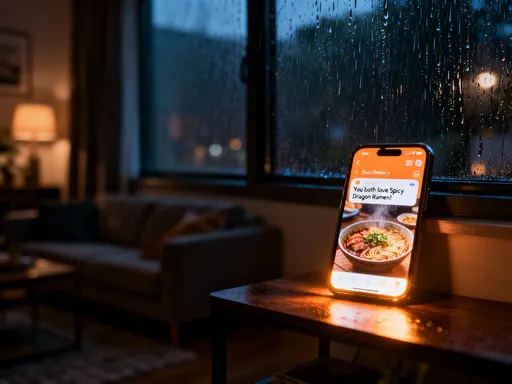
It was a typical Thursday—gray skies, leftover work, and a fridge that said, “Nothing here.” I opened my food delivery app, the same one I’ve used for years, and started browsing my usual spots. There’s comfort in routine, isn’t there? You know what you like, where to get it, and how long it takes to arrive. But as I scrolled, a little pop-up caught my eye: “You both love Spicy Dragon Ramen!”
At first, I thought it was a glitch. Who was “both”? Then I saw it—a name linked to the notification. Sarah.
My breath caught. Not because of the ramen, but because of what it meant. She was still using the app. She still liked the same place. And somehow, the algorithm had remembered what I’d forgotten: that this was our spot. We used to joke that if the world ended, we’d want our last meal to be those rich, spicy bowls with extra soft-boiled eggs. We even gave the delivery guy a nickname—“Ramen Ranger.”
The app didn’t say any of that, of course. It just showed a shared preference. But to me, it felt like a message. Not from the company, not from marketing, but from life itself. Like the universe had whispered, “She’s still out there. And she still remembers.” I don’t know why, but I suddenly felt lighter, like a weight I hadn’t noticed was finally lifting. That little notification wasn’t just about food. It was proof that some things—some people—don’t disappear, even when silence grows between them.
How Food Preferences Keep Memories Alive
We don’t just eat to survive. We eat to remember. A bite of something familiar can transport you—back to childhood kitchens, holiday tables, or late-night dorm room feasts. Food is emotional. And when technology starts tracking that, it’s not just collecting data. It’s preserving stories.
Seeing Sarah’s name next to that ramen order didn’t just remind me of a meal. It brought back the smell of soy sauce and chili oil, the sound of rain against our window, the way we’d split a single order because we were broke but happy. I remembered how we’d text each other screenshots of our deliveries like we were sharing treasure. “Got the dumplings!” “Nailed the pad thai!” It was our version of staying close.
The app didn’t know any of that. It couldn’t capture the laughter or the tears we shared over those meals. But it did know our patterns. It knew we both ordered on rainy nights. It knew we preferred spicy food when stressed. It knew we went silent during tax season and came back with double orders after deadlines. In its own quiet way, the app had become a keeper of our rhythms.
That’s the thing we often miss about technology—we focus on what it can’t do, but overlook what it quietly does. It doesn’t replace memory, but it can trigger it. It doesn’t feel emotion, but it can reflect it back to us in unexpected ways. When I saw that shared preference, I didn’t see code or data. I saw a mirror. And in it, I saw a version of myself—and a friendship—that was still alive, just waiting to be acknowledged.
From Algorithm to Authentic Conversation
I stared at her profile for a long time. Should I say something? Was it weird? What if she didn’t remember me the way I remembered her? My fingers hovered over the message button. And then, I thought—what’s the worst that could happen? She doesn’t reply. But what if she does?
I typed: “Still obsessed with that ramen, huh?”
Three dots appeared. Then: “Only because you introduced me to it!”
And just like that, we were talking. Not in stiff updates, but in the easy rhythm we’d always had. She told me about her new job, her dog, her failed attempt at making ramen at home. I told her about my garden, my kids, my latest cooking disaster. We sent voice notes—laughing, interrupting, finishing each other’s sentences. It felt like no time had passed, and also like we’d both grown so much.
That conversation lasted over an hour. We ended with a promise: “Let’s actually meet up soon.” And this time, I believe we will. Because the app didn’t force us to reconnect. It didn’t send us a push notification saying, “Talk to your old friend!” It simply created a moment of recognition. A tiny spark. And sometimes, that’s all it takes.
This is the quiet power of everyday tech. It doesn’t shout. It doesn’t demand attention. But when it pays attention to us—really pays attention—it can give us back something precious. Not just convenience, but connection. Not just efficiency, but meaning. And in a world where so much feels rushed and shallow, that kind of depth is rare.
Designing for Emotional Resonance, Not Just Efficiency
We expect our apps to be fast. We want them to be accurate. We complain when delivery is late or the wrong item shows up. But we rarely ask: can this app also be kind? Can it be thoughtful? Can it help us feel seen?
The feature that showed me Sarah’s order wasn’t designed for friendship. It was meant to personalize recommendations, to keep users engaged, to boost sales. But in practice, it did something deeper. It created a moment of emotional resonance. It said, without words, “You’re not alone in this. Someone else out there shares your taste, your habits, your little joys.”
Imagine if more technology was built with this kind of care. Not just to move us faster from point A to point B, but to remind us of who we are and who we’ve loved. What if your music app said, “You and Lisa both played this song 37 times during breakup season”? Or your calendar reminded you, “It’s been 8 months since you had coffee with your sister”? These aren’t gimmicks. They’re invitations—to care, to reach out, to remember.
When apps remember our behaviors, they do more than predict what we’ll do next. They reflect our lives back to us. And when they highlight shared patterns with people we care about, they become more than tools. They become witnesses. They say, “This matters. This connection. This history. I see it too.”
That’s the shift we need: from technology that serves us, to technology that sees us. Not in a creepy, invasive way, but in a gentle, affirming one. A nudge that says, “Hey, remember her? She’s still out there.” That’s not just good design. That’s humanity, quietly coded into the background of our daily lives.
Practical Ways to Use Food Apps for Connection
You don’t need a dramatic plan to reconnect. Sometimes, the smallest gesture is the most powerful. And the tools are already in your pocket. Here’s how I’ve started using my food app differently—not just to feed myself, but to feed my relationships.
First, I check my shared favorites list. Most apps now show restaurants you and a contact both love. When I see one, I send a quick message: “Still craving that burger place?” It’s light, it’s warm, it doesn’t demand a long reply. But it opens the door.
Second, I send surprise meals. Last week, I ordered a slice of banana cream pie—our college diner’s specialty—for Sarah, with a note: “Remember midnight study breaks?” She called me in tears. Not because of the pie, but because someone remembered. You can do this for a cousin, an old neighbor, a work friend who moved away. No need to say much. Just, “Saw this and thought of you.”
Third, I use shared wish lists. I created one with my sister—“Our Comfort Foods”—and we add to it whenever we find something new. It’s become a kind of ongoing conversation. She’ll add a new taco spot; I’ll reply with a photo of my order. It’s not constant, but it’s consistent. And that’s what matters.
And finally, I pay attention to patterns. If I see someone ordered on a tough day—say, during a holiday or after a busy week—I’ll send a simple, “Hope today was kind to you.” It’s not about fixing anything. It’s about saying, “I see you. I’m here.”
These aren’t grand gestures. They don’t require planning or pressure. But they build up. They create threads that can turn into bridges. And they use the same apps we already trust for dinner to deliver something even more nourishing: connection.
Reclaiming Technology as a Tool for Warmth
We’ve been taught to fear technology. That it’s stealing our attention, damaging our relationships, making us lonely. And yes, it can. But it doesn’t have to. Like any tool, it depends on how we use it. A knife can harm, or it can prepare a meal that brings people together. The same is true for our apps.
That rainy night, I didn’t just get dinner. I got a friend back. Not because the app was perfect, but because it paid attention in a way I hadn’t. It remembered what mattered. And it gave me the courage to reach out.
Technology doesn’t have to be cold. It can be a quiet companion in our lives—holding memories, reflecting our habits, and sometimes, handing us a thread we thought was lost. We don’t need more features. We need deeper ones. Ones that honor our humanity, our history, our hearts.
So the next time you open your food app, don’t just think about what you want to eat. Think about who you might reconnect with. Who shares your taste? Who used to laugh over the same meals? Who might light up at a surprise order or a simple message?
Because the truth is, we’re not just feeding ourselves when we order dinner. We’re shaping our lives. And sometimes, with the smallest nudge, we can turn a routine moment into a reunion. We can turn data into care. We can turn an app into a love letter.
And that—more than speed, more than convenience—is the future I want. One where technology doesn’t just serve us, but stays with us. Where it helps us remember. Where it helps us say, “I still care.” And where a shared ramen order can bring someone back into your world, one bite at a time.